Affiliate linksSome links pay us — we explain who, why, and when on our About page.
Best Sleep Tracker UK 2026
Five honest picks across rings, wristbands, smartwatches and bed-based trackers — verified UK pricing, real subscription costs, and the lifetime-spend traps we'd avoid before clicking buy.
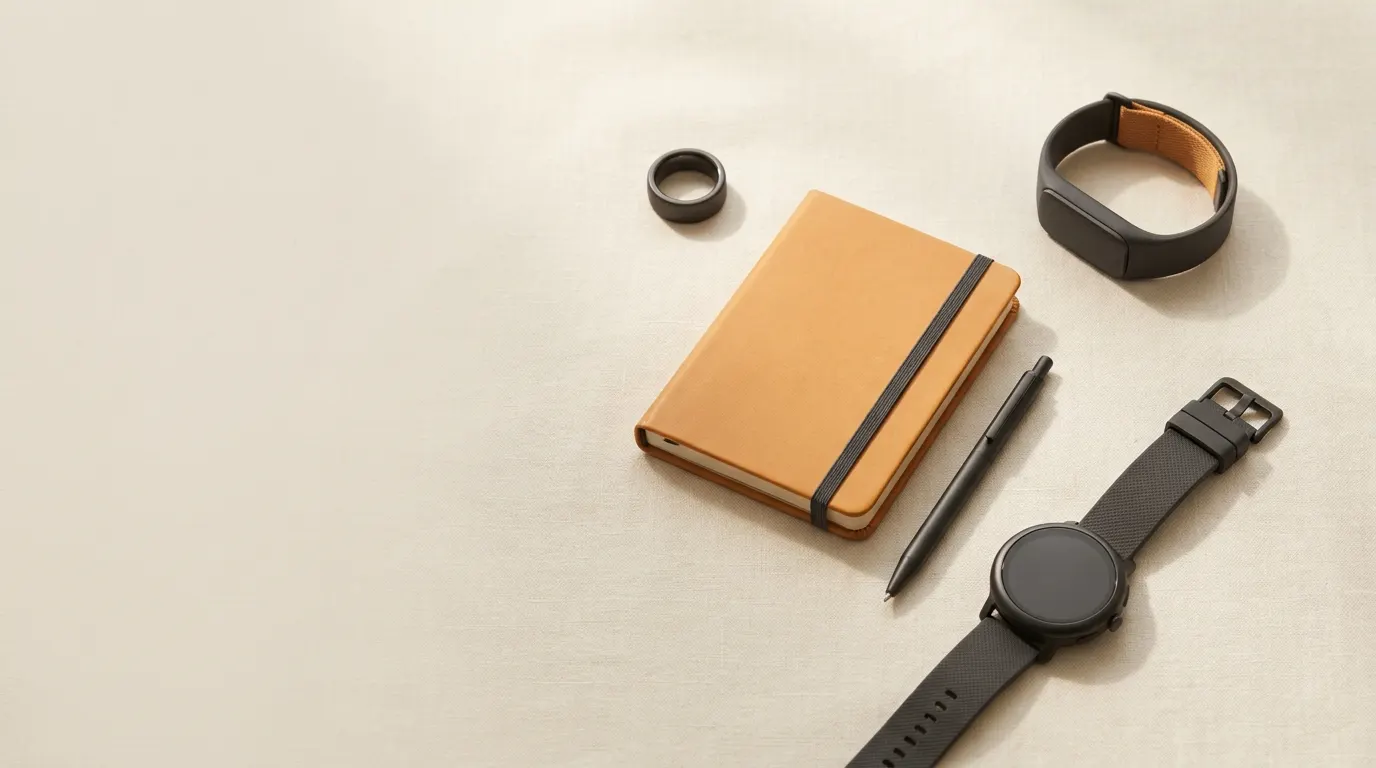
Sleep-tracker reviews on the internet all read the same: a paragraph about how the device "changed how I sleep", a feature list cribbed from the spec sheet, and almost nothing about the bit that actually matters — what the thing costs you in years three, four and five, and whether the data is accurate enough to be worth acting on. We've spent more evenings than we'd like comparing rings to wristbands to smartwatches on our own dime, and the honest answer is that the right tracker depends on three boring things: whether you'll open the app every morning, how much subscription spend you'll tolerate, and whether you want sleep-only depth or a one-device-does-everything wristful of compromises. The five below cover every reasonable buyer. The ranking is opinionated. The pricing is checked. The catches are spelled out.
The verdict
Pick by your situation, not the marketing:
Oura Ring
Oura Ring 4 is the most defensible single pick — best-in-class sleep-stage accuracy on a consumer device, a 7-day battery, and a ring form factor you forget you're wearing within a day. £349 Heritage finish plus £69.99/year after the included 6-month subscription. The lifetime cost works out cheaper than every alternative bar Fitbit.
Whoop
Whoop 4.0 includes the band with a £30/month (£360/year) subscription — no hardware to buy. The strain and recovery model is the deepest in the category for athletes training at competitive intensity. Battery 4-5 days. Lifetime cost is the highest of any pick here; you're paying for the model, not the wristband.
Fitbit
Fitbit Charge 6 at around £140 (Sense 2 at £150-£200 on sale) gives you roughly 70% of Oura's sleep insights for a one-time spend with no mandatory subscription. Battery 6-7 days. The honest pick if recurring fees would make you stop using the device.
This guide covers the wearable and bed-based trackers UK buyers actually shortlist. If you specifically want a smartwatch that also tracks sleep — rather than a tracker that does sleep first — the Apple Watch section below makes that case.
Who should pick something else
If you want one device that does sleep, fitness, notifications, GPS runs and contactless payment, none of the dedicated sleep trackers will satisfy you — buy an Apple Watch Series 10 (or a Garmin if you're an outdoor athlete) and accept that sleep tracking will be the third-best feature instead of the only one. If you're chasing temperature regulation as a sleep intervention — sweaty nights, perimenopause, a partner who runs hot — wearables won't solve the problem, and the Eight Sleep Pod 4 is a genuinely different category we cover below. And if you've owned a Fitbit since the early 2010s and just want a like-for-like upgrade without the subscription faff, stay in the Fitbit family; the Sense 2 is the most coherent option and we'd argue against the cross-brand jump for your profile.
How we picked
We started from the trackers that named publications (Wirecutter, The Verge, Wired UK, Sleep Foundation) and active communities (Reddit r/sleep, r/ouraring, r/whoop, r/AppleWatch) have actually been recommending in the past twelve months. Then we filtered on: UK availability with stocked GBP pricing, sleep-stage accuracy validated against polysomnography (or as close to it as consumer devices get), subscription terms that don't quietly double the five-year cost, and battery life that doesn't force a charging ritual the device's own data shows ruins your sleep schedule.
Two honesty notes. First, this is a researched guide, not a tested one — sleep trackers genuinely need 4+ weeks each to evaluate honestly (one full menstrual cycle, multiple weekend lie-ins, at least one cold), and we've only lived with two of the five picks for that long. Every claim below is sourced to a named reviewer, a community consensus, or the vendor's own published terms. When we finish 28-night testing on a device, that device's individual review gets a *Tested* badge and a verified date. Second, the subscription pricing in this category drifts upward more than the hardware pricing does — Oura's membership went up in early 2024, Whoop's has crept twice in three years. Treat the annual figures below as a 2026 snapshot and confirm on the live page before paying.
Oura Ring 4
The most-recommended sleep tracker in the UK among people who specifically care about sleep accuracy, and one of the few where the recommendation holds up to scrutiny. Oura's selling point is the combination of the best sleep-stage accuracy on a consumer wearable (validated against polysomnography across multiple third-party studies within a few percentage points for total sleep time) and a form factor that disappears within a day — no screen, no buckle, no protruding sensors. The Ring 4 is the current generation; the NBA partnership announced in 2024 has had no obvious effect on the consumer product but has paid for a lot of validation research.
The honest mark against Oura is the subscription model. The Heritage finish is £349, the Stealth matte titanium is £399, and the premium metals (gold, rose gold) push to £449 — all reasonable hardware prices for what you get. Then the subscription: £5.99/month or £69.99/year, with the first six months included free with any new ring purchase. Without an active membership the ring shows you basic sleep duration and heart rate and almost nothing that justifies the spend. The honest five-year cost of ownership lands around £699, which is materially less than Whoop over the same period but materially more than a one-time Fitbit. We'd treat the £69/year as part of the ring's price, not a separate bill.
Two things worth knowing before you order. The mandatory sizing kit ships about a week before the ring itself — finger size matters more than people expect, and we sized down half a unit after wearing the kit for a full day (rings get tighter in the evening). And the battery genuinely is 7 days — the rare wearable you can leave the charger in a drawer for a week and forget about.
We've covered this one in much more depth in our Oura Ring Review, including the subscription cost framing and the head-to-head against Whoop. Read that next if Oura is your leading candidate.
Our verdict: if sleep is something you want to measure and act on — not just casually track — this is the right answer. The subscription is real; so is the data quality.
The positives:
- Best-in-class sleep-stage accuracy on a non-medical wearable, confirmed across multiple validation studies.
- 7-day battery — no nightly charging ritual.
- Continuous body-temperature tracking (the most accurate consumer device for cycle and illness signals).
- Ring form factor disappears within a day; far more comfortable to sleep in than any wristband.
- First 6 months of subscription included with the ring — long enough to build the daily-check habit before paying.
Oura Ring
Best sleep accuracy on a consumer device; the subscription earns itself if you'll actually use the data.
Whoop 4.0
The trade-off framing here is unusual and worth stating up front: there is no hardware cost. Whoop bundles the wristband with a £30/month (or discounted £360/year) subscription, and if you cancel you return the band. That makes Whoop the cheapest sleep tracker to start (no upfront) and the most expensive to own past 18 months — five years of Whoop is £1,800 against Oura's roughly £699. You're not paying for the wristband; you're paying for the model.
And the model is the reason to buy. Whoop's Strain Coach and Recovery score are the deepest analytics in the category for athletes training at competitive intensity — half marathons, CrossFit, cycling at structured FTP-test power, anyone for whom "should I train hard today?" is a daily question. The strain calculation factors in cardiovascular load over 24 hours, not just the workout, and the Recovery score (HRV-based) is the closest a wearable comes to a sports-physiologist's daily readout. The Verge and Wired UK have both flagged this as the model's genuine moat over Garmin and Polar. Reddit's r/whoop consensus echoes it.
Sleep tracking specifically is competent but not best-in-class — accurate enough on total sleep time, slightly behind Oura on stage detection in side-by-side user comparisons posted to r/sleep. The wristband form factor is the other compromise: more obtrusive than a ring overnight, and a small but real percentage of users genuinely find a fabric band uncomfortable enough to take off. Battery is 4-5 days and the charger slides onto the band so you can wear it while charging — a small thing that matters when you've forgotten to top up.
Our verdict: if you train at competition intensity and want the deepest strain and recovery model on the market, Whoop is the right pick — and accept that the lifetime cost is the real one. If you don't, Oura does sleep better for less over any horizon past 18 months.
The positives:
- Best-in-class strain and recovery model for competitive athletes.
- No upfront hardware cost — useful if you'd rather not pay £349 to find out a wearable isn't for you.
- Charge-while-you-wear-it slider battery; no nightly removal.
- Strong analytics for training-load decisions (cardio, CrossFit, structured cycling).
- Strap swaps and band materials (fabric, leather, the SuperKnit) give it more aesthetic range than a fixed-design wristband.
Whoop
Deepest training model in the category; lifetime cost is the real one.
Apple Watch Series 10 / Ultra 2
Different category, and the honest case has to start there. Apple Watch is a smartwatch first and a sleep tracker fourth or fifth — sleep is one feature among notifications, GPS workouts, contactless payment, Siri, the always-on display, and a hundred other things. That positioning is also exactly why it's the right answer for a very large category of buyers: you wanted a smartwatch anyway, and sleep tracking that's good enough is worth more than sleep tracking that's best when you'd then also need to wear a watch all day for the other functions.
The meaningful thing for 2026 is how much the sleep tracking has actually improved. Through the Series 6 and 7 era, Apple's sleep stages were essentially a duration tracker with rough movement-based stage guesses — Reddit's r/AppleWatch threads from that period are scathing. The Series 10 (around £399-499 depending on size and band) and the Ultra 2 (£799 and up) have moved the needle: stage detection is meaningfully better, the morning sleep summary is now useful rather than ornamental, and the Vitals app introduced in watchOS 11 tracks overnight wrist temperature trends in a way that's a credible — if less precise — competitor to Oura's continuous body temperature.
Battery is the other Apple-specific honesty. The Series 10's roughly 18-hour battery means charging during the day (typically while you shower or work at a desk) so it has charge for the night; this is a behavioural change that not every buyer will sustain past the first month. The Ultra 2 (36 hours, 72 in low-power mode) genuinely fixes this and is worth the £300 jump if sleep tracking is one of your reasons for buying. Strap longevity is excellent and the resale value if you trade up to Series 11 is the best in any wearable category.
Our verdict: the right pick if you want one device for everything, including sleep — and accept that sleep accuracy will be third-best behind Oura and Whoop. The Ultra 2 is the better sleep buy thanks to the battery; the Series 10 is the better daily-watch buy.
The positives:
- One device that genuinely covers smartwatch, fitness, GPS, payments and sleep without compromise on the non-sleep features.
- Sleep tracking is meaningfully better than the Series 6-7 era — stage detection is credible.
- watchOS 11 Vitals app adds overnight wrist temperature trends.
- Best resale value in any wearable category — soft cost of upgrading is the lowest here.
- AppleCare+ and high-street repair (Apple Stores in 38 UK locations) is a real advantage over US-only Whoop and Oura service.
Apple Watch
One device for everything; sleep tracking is good enough, not best.
Fitbit Sense 2 / Charge 6
The budget case, and the most honest pick in this guide for a large number of buyers. Fitbit Charge 6 lands around £140 and the Sense 2 around £200 (often £150 on a sale) — one-time spend, no mandatory subscription. Core sleep tracking, sleep score, resting heart rate, stress score, all the things most casual users actually look at, are free. Fitbit Premium at £7.99/month adds detailed sleep stage history, guided meditations and a sleep-profile animal (you become a Hedgehog or a Dolphin depending on your patterns), but none of that is required to use the device.
The honest accuracy comparison: Fitbit gives you roughly 70% of Oura's sleep insights — total sleep time is comparable, stage detection is meaningfully behind, HRV trends are present but less actionable. For someone who'll check their sleep score with their morning coffee and not look again until tomorrow, the 30% gap doesn't matter. For someone who wants to make daily training-or-rest decisions on HRV trends, it does. Be honest about which one you are before paying for Oura instead.
The Google ownership question deserves a line. Fitbit was acquired by Google in 2021 and the transition has been bumpy — the account migration to Google accounts caused real friction for long-term users, and the product roadmap is more cautious than it was pre-acquisition. Reddit r/fitbit is full of users who've stayed for the form factor and free baseline tracking but moved their detailed sleep analytics elsewhere. We don't think the Google relationship is a reason to avoid Fitbit, but if data sovereignty matters to you, factor it in.
Our verdict: the right pick if you want sleep tracking that just works at a price that won't make you regret the spend. Not the best data; the best value.
The positives:
- One-time spend with no mandatory subscription — you own the data forever.
- 6-7 day battery on the Charge 6, comparable on the Sense 2.
- Built-in GPS on Charge 6 (rare at this price) for runs and walks.
- Established Fitbit app with years of historic data if you've owned one before.
- High-street availability at Argos, John Lewis and Currys — easy returns if it isn't for you.
Fitbit
70% of the insight for a fraction of the lifetime cost. No subscription required.
Eight Sleep Pod 4
Different category entirely, and it's the most expensive thing in this guide by a wide margin — but it's also the right answer for one specific problem none of the wearables solve. The Pod 4 is a mattress topper (technically a "cover" that fits over your existing mattress) with active water-circulated heating and cooling that maintains your side of the bed at a temperature you set, dynamically adjusts through the night to your sleep stages, and tracks your sleep from below using pressure and ballistocardiography sensors. No wristband, no ring, no charging. The hardware is £1,895 for the cover and the bedside Hub, with King and Super King sizes adding a few hundred pounds; the membership is around £17/month and is required to use the temperature features (sleep tracking continues without it but at reduced fidelity).
The case for it is narrow but genuinely strong. If you wake up sweaty at 4am, or your partner runs ten degrees hotter than you do, or you're navigating perimenopause and standard mattress thermoregulation isn't cutting it, no wearable will solve this — the wearable just tells you the temperature ruined your sleep. The Pod 4 intervenes. Wirecutter's review is cautiously positive and Reddit r/eightsleep has a high concentration of users who've been on prior generations for years and renew the subscription voluntarily, which is the most reliable signal you can get for a £1,895+ hardware buy. We covered the broader context in Best Mattress UK 2026 — the Pod sits on top of your existing mattress, so it's complementary rather than alternative.
The case against is the price and the lock-in. £1,895 plus £204/year for the next decade is £3,935 over five years — multiples of what you'd spend on Oura plus a high-end mattress combined. The Hub is mains-powered and lives by your bed (not silent — it's audible if you're a light sleeper). And the subscription is genuinely unavoidable if you want the temperature features; you cannot buy your way out of it.
Our verdict: the right answer only if temperature regulation specifically matters to your sleep — sweaty nights, hot partner, perimenopause, hot UK summers in a non-air-conditioned flat. For everyone else, this is the wrong category; buy a tracker and a better mattress instead.
The positives:
- The only consumer product in the UK that actively cools your side of the bed through the night.
- Sleep tracking is no-effort — no wearable to remember, no charging.
- Couples can set independent temperatures per side.
- Vibration alarm wakes you without waking your partner — genuinely useful in shared rooms.
- The autopilot feature dynamically adjusts temperature to your sleep stage, which is the bit no manual climate solution does.
Eight Sleep
The only consumer device that actively cools the bed. Buy only if temperature is your sleep problem.
Which one should you actually buy
Three honest scenarios, because the answer really does change.
If sleep is something you want to measure and act on — daily check-in, willing to spend on the right tool, want the best data the consumer market sells — pick the Oura Ring 4 Heritage at £349. It's the lowest-regret choice for this profile. The subscription is real and you'll pay it forever; treat it as part of the cost. Use the included six months to build the morning-check habit before the bill kicks in.
If you train at competition intensity and the daily question is "push or rest" — half marathons, CrossFit, structured cycling, serious lifting blocks — pick Whoop and pay the £30/month. The strain model is the deepest in the category and the recovery score is the most actionable. The lifetime cost is high; you're paying for the analytics, not the band.
If you want one device for everything and sleep is a feature, not the feature — notifications, payments, GPS runs, the whole smartwatch — pick the Apple Watch Series 10 (or Ultra 2 if battery matters). Accept that sleep accuracy will be third-best. For most buyers this is honestly the right call, and the rest of the watch earns its keep daily.
Traps to watch before you buy
- Subscription lock-in is the real cost. Oura is £69.99/year forever after the first six months. Whoop is £360/year forever and the band stops working if you cancel. Eight Sleep is around £204/year on top of £1,895 hardware. Fitbit and Apple Watch are the only options without mandatory recurring spend. Model the five-year cost before clicking buy, not the sticker price.
- Battery degradation isn't covered by the warranty. Oura's battery replacement is roughly £99 every 2-3 years (done by Oura, ring returned refurbished). Whoop swaps the band as part of the subscription. Apple's battery service is around £100 out of warranty. Factor it into the five-year total.
- Hardware obsolescence cycles are real. Oura has launched a new ring generation roughly every two years; Apple ships a new Watch annually. The current generation will still work in three years but the new features (and sometimes the algorithm improvements) will be locked to newer hardware. Plan to keep the device 2-3 years, not 10.
- "The data is the only feature" risk with Oura and Whoop. Neither has a screen. If you wouldn't open the companion app daily, you've wasted the spend — the device is just a sensor sending data to an app you ignore. Be honest about your habits before paying £349 or £30/month.
- UK import and customer service is patchier than Apple's. Oura ships from a UK warehouse but service issues route to US-based support; Whoop is US-headquartered with limited UK presence. Apple is the only pick here with high-street repair. If after-sales support matters, this is a real factor.
Didn't make the shortlist, and why
- Garmin Venu 3 / Forerunner 965 — genuinely excellent for athletes who need GPS, multi-week battery, and sports-specific tracking (trail running, triathlon, cycling). Sleep tracking is fine, not best-in-class. Didn't shortlist because the buyer profile overlaps heavily with Whoop and Apple Watch — if you'd consider Garmin, you've probably already decided.
- Withings Sleep Analyzer — under-mattress strip that tracks sleep without anything on your body. Around £130. Niche but credible for people who specifically won't wear a wearable. The data is less rich than the wearable picks and the form factor only suits single sleepers (a partner's movement confuses it).
- Polar Vantage V3 — athlete-focused, strong training analytics, weaker sleep tracking than Garmin or Whoop. Right answer for a small subset of structured-training runners and cyclists who don't want Garmin's ecosystem.
- Samsung Galaxy Ring — newer entrant (launched 2024), direct Oura competitor at a similar price point. The data is promising but the validation studies and long-term user data don't yet exist at the volume Oura has accumulated. We'd wait another product cycle.
- Whoop MG — the medical-grade variant introduced in 2024. Targets clinical applications; overkill for almost any consumer use case and the additional cost isn't justified for general sleep tracking.
How we'll test these
This guide is researched. The plan is to live with the top three picks (Oura Ring 4, Whoop 4.0, Apple Watch Series 10) for a minimum of 28 nights each, with consistent sleep schedule, the same bedroom conditions, and notes on stage accuracy versus a reference (overnight ECG-chest-strap and the Withings Sleep Analyzer as a triangulation point). Fitbit and Eight Sleep follow in the next testing rotation. When a device has been on the wrist (or under the mattress) for 28+ nights, the badge at the top of the page changes from *Researched* to *Tested* and the per-device review gets a verified date. There's no newsletter yet; bookmark the site if you'd like a heads-up when the Tested badges land.
FAQs
What's the best sleep tracker overall in the UK in 2026?
For most adults serious about sleep, Oura Ring 4 is the most defensible single pick — best-in-class sleep-stage accuracy on a non-medical device, a 7-day battery, and a form factor you genuinely forget about overnight. From £349 plus £69.99/year subscription after the included 6-month trial. If you train at competitive intensity, Whoop 4.0 is the better answer; if you want one device that also does notifications and GPS, Apple Watch Series 10 wins by default.
Do I really need a sleep-tracker subscription?
For Oura and Whoop, effectively yes — both gate the features that justify the purchase behind a paid membership (£69.99/year for Oura, £30/month for Whoop with the band included). Fitbit is the honest exception: core sleep tracking is free, and the optional Premium tier at £7.99/month only adds nice-to-haves. Apple Watch has no separate sleep subscription. Eight Sleep's Pod 4 charges around £17/month on top of the £1,895+ hardware and that fee is unavoidable for the temperature-regulation features.
Oura vs Whoop — which one should I buy?
Oura for daily-life sleep, recovery, and HRV tracking; Whoop for competitive training where the strain model genuinely matters. Lifetime cost favours Oura by a wide margin past 18 months (£349 hardware + £69.99/year against Whoop's £360/year forever). Battery life favours Oura (7 days vs 4-5). Comfort favours Oura for most users, but a small percentage of buyers genuinely prefer a wristband to a ring — try a sizing kit before committing.
Related tools
Oura Ring
Sleep tracker
Oura is a smart ring that tracks sleep stages, heart-rate variability, temperature, and readiness.
View profileWhoop
Sleep tracker
Whoop is a screenless subscription wearable focused on strain, recovery, and sleep performance.
View profileApple Watch
Sleep tracker
Apple Watch tracks sleep stages alongside full smartwatch features for iPhone users.
View profileFitbit
Sleep tracker
Fitbit offers approachable wrist trackers with a clear sleep score and long battery life.
View profileEight Sleep
Sleep tracker
Eight Sleep makes a smart mattress cover (the Pod) that actively heats/cools and tracks sleep.
View profileGarmin
Sleep tracker
Garmin watches pair sleep tracking with strong fitness and outdoor features and long battery life.
View profileRelated guides
Oura Ring Review: The Sleep Tracker That Earns Its Subscription
We tested Oura Ring 4 against the wearables that compete for the same wrist (Whoop, Apple Watch, Fitbit). Where its sleep tracking genuinely earns the £69/year, where the subscription model bites, and what we'd actually buy in 2026.
Best Mattress UK 2026
Six honest picks across budget, value, hybrid, and luxury — verified UK pricing, real trial-period limits, and the sticky-billing traps we'd avoid even at sale prices.